

How to run effective ABM campaigns in HubSpot
Discover how to optimize account-based marketing in HubSpot to target high-value accounts and boost conversions.
Your sales team is wasting time on accounts that will never close. Meanwhile, your best prospects get the same generic emails as everyone else.
Effective sales teams know that full pipelines and meeting quotas don’t happen by accident.
Sure, you can get a call booked by playing the numbers game, but consistently driving results (and closing deals) requires a lot more than luck. The missing ingredient is Account-Based Marketing (ABM).
Don’t worry, this isn’t something that will take months to implement. In this guide, I’ll give you the exact playbook I’ve used to build an ABM strategy inside HubSpot. I’ll also show you my favorite tools to integrate with HubSpot, and other expert tips to level up your strategy.
What is Account-Based Marketing?
You know that spray-and-pray sales approach everyone seems to love?
ABM is the exact opposite of that.
Rather than throwing spaghetti at the wall to see what sticks, ABM is a targeted approach in which marketing and sales teams work together to reach high-value accounts, personalize outreach, and nurture prospects through the sales process.
In other words: focus on high-value and engaged leads, and tune out the rest.

The core principles of ABM
Alright, that’s great in theory, but what does it actually mean?
Before implementing an ABM strategy, you need to understand its three core principles:
- Personalization: ABM starts with tailored messaging, smart content, and individualized engagement to build strong relationships with prospects. By adapting content based on what prospects do or where they sit in the buyer’s journey, you improve your odds of being heard.
- Targeted Outreach: Instead of reaching a general audience, ABM targets accounts through specific channels, such as LinkedIn, personalized email campaigns, and direct sales engagement, ensuring messaging is tailored to the right accounts.
- Sales & Marketing Collaboration: ABM hinges on close alignment between marketing and sales teams to deliver a seamless experience across all touchpoints. That way, whether someone gets a newsletter or chats with you, they’re hearing the same message.
Read on for a blueprint for implementing this in HubSpot.
Why ABM matters for B2B marketing and sales teams
Is all the above work really worth the effort?
Well, did you know that companies using ABM tools report a 171% increase in their average contract value compared to those using a traditional sales funnel?
Sales and marketing teams across industries are finding that it’s not enough to simply exist or even show up. Traditional lead-generation strategies that focus on acquiring large volumes of leads are proving to be less effective thanks to AI slop flooding inboxes and the internet, making way for ABM.
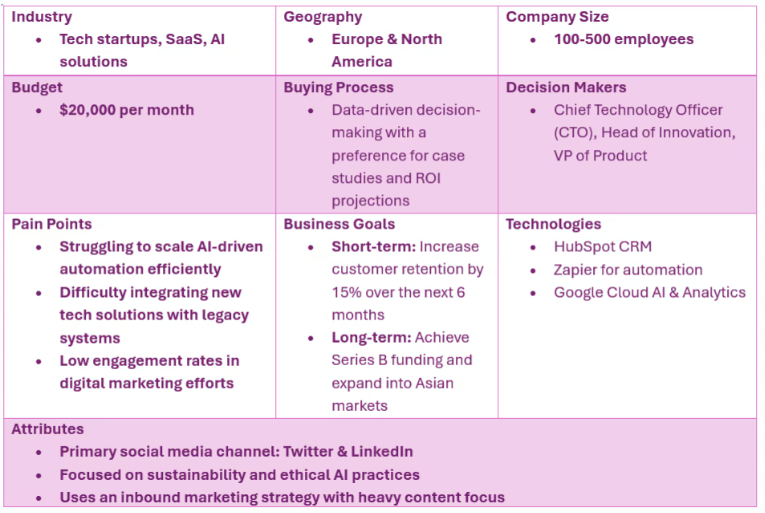
ABM prioritizes high-value accounts, optimizing resources for deeper engagement and faster conversions using ideal customer profiles (ICP). By focusing on fewer but more strategic prospects, businesses drive efficiency, accelerate sales, and enhance long-term customer retention.
How to build an ABM strategy in HubSpot
HubSpot is the perfect marriage between top-notch marketing tools and cutting-edge sales tools, making it one of the best CRMs for ABM.
And building an effective ABM strategy in HubSpot can be dead-simple. Just follow these steps:
- Identify your target accounts
- Activate HubSpot’s ABM tools
- Launch personalized campaigns
- Measure and optimize as you go
Identify your target accounts
ABM starts with knowing exactly who you want to target and what makes an account a priority.
Start by reviewing your CRM. Look through historical data, deal wins and losses, and customer behavior to determine which accounts are most likely to convert. This can take a while, but trust me, the preparation here is well worth the effort.
I recommend segmenting accounts into the following tiers:
- Tier 1: High-priority accounts with the greatest revenue potential.
- Tier 2: Moderate-fit accounts that align with business goals but require additional nurturing.
- Tier 3: Low-fit accounts that may show interest but are not an immediate focus.
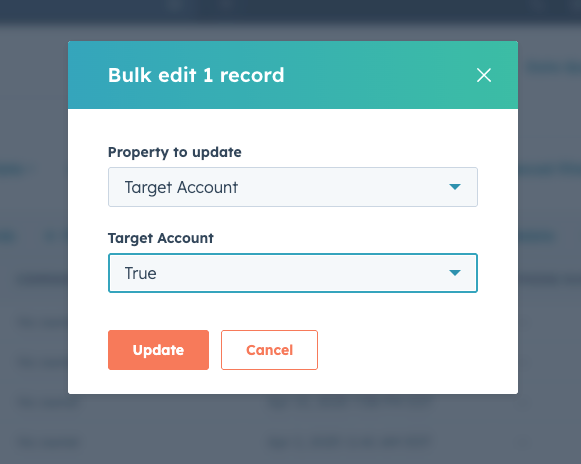
In HubSpot, you can mark companies as target accounts by updating the Target account property to True.
The point is that you need a rubric to determine whether an account is a priority. Learn more about how to tier accounts in this guide. Once you’ve mapped out your target accounts, move on to the next step.
Activate HubSpot’s ABM tools
Before you start with HubSpot ABM, ensure you are either a Super Admin or have Account access permissions, as these are required to activate HubSpot’s ABM features.
Once verified, follow these steps:
- Navigate to CRM > Companies > See Target Accounts
- Click "Get Started"
- Configure your HubSpot ABM parameters
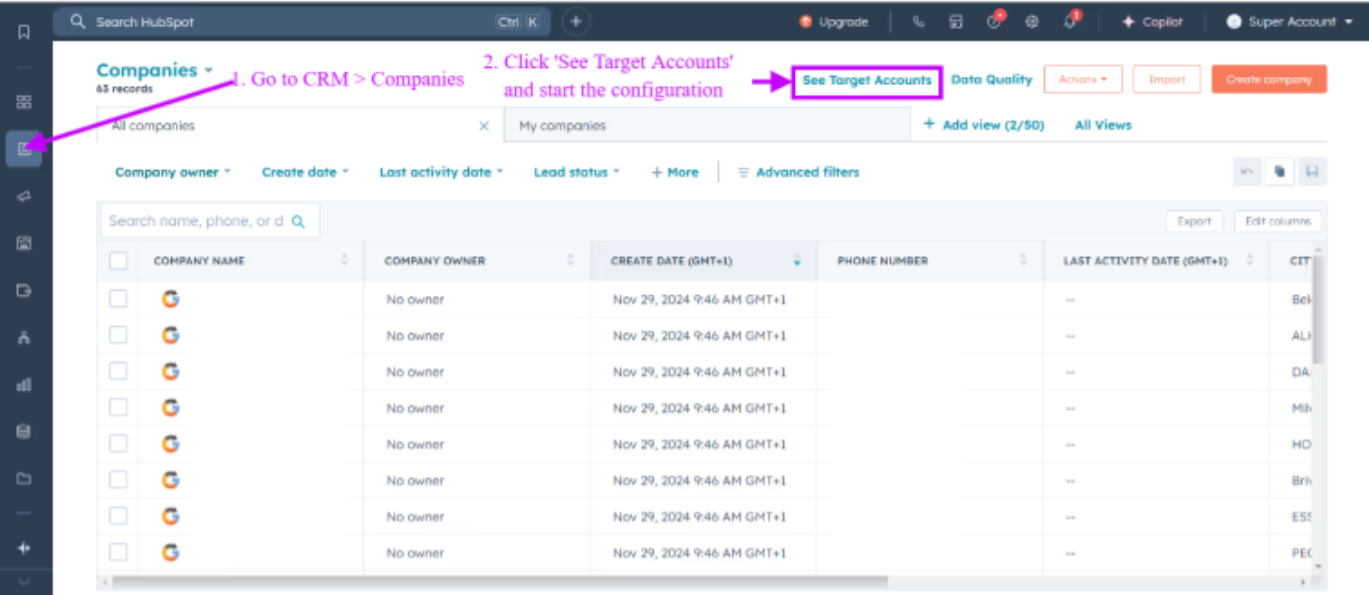
Once activated, HubSpot automatically generates an ABM reports dashboard, allowing you to track engagement and manage multiple target accounts efficiently. This is your new sales command center, so take time to familiarize yourself with these reports because you will use them often!
Launch personalized ABM campaigns
Once your target accounts are set and you activate the ABM tools in HubSpot, it's time to implement personalized outreach strategies.
This is where the rubber hits the road. You can’t just send generic marketing messages to all your contacts and hope the fancy HubSpot dashboards somehow make it work. Instead, review the accounts in your tiers and draft up campaigns that speak directly to the needs of your top accounts.
This takes work… lots of it. That’s why it’s so important to prioritize your highest-value accounts.
Here are a few things to try:
- Segment contacts with lists: Segment contacts in your accounts into lists. This ensures that different stakeholders within an account receive targeted messaging based on their role in the buying process.
- Use sequences and workflows for automation: Write your messages and schedule them into email sequences. This allows you to scale your outbound strategy and pre-schedule targeted messages to prospects. Make sure you adjust messages based on how the recipient interacts with previous outreach.
- Trigger messages based on prospect activity: Success in sales is 99% timing (and persistence). Partner with Marketing to create workflows that are triggered by prospect actions. As prospects visit key pages, engage with content, or enter your funnel but stop somewhere, trigger timely messages that speak to them directly based on where they are and what they are doing.
- Drive traffic to targeted pages: This is where good old marketing comes into play. Work with your marketing team to create industry-specific landing pages that speak directly to the industry challenges, goals, and expectations for your target accounts. You can partner with your marketing team to run advertising or organic campaigns on these pages, or use them when messaging prospects.
I could give you a million more ideas, but it boils down to this: once you’ve identified your target accounts, it’s time to run outreach campaigns to reach them.
Call, email, text, or message on LinkedIn and partner with your marketing team to hyper-focus on your best prospects to earn their time and attention.
Measure & optimize sales performance
You’re done, right?
Not even close. The above work is the hard grunt work of sales outreach, but you can make it easier on yourself by measuring and optimizing as you go.
After launching ABM campaigns, regularly review target account activity and track performance metrics by creating reports. To evaluate the success of ABM efforts, businesses should focus on key performance indicators such as:
- Account Engagement: Measuring how target accounts interact with emails, content, and marketing campaigns.
- Pipeline Velocity: Assessing how quickly ABM-targeted deals move through the sales cycle.
- Conversion Rates: Tracking how many high-value accounts convert into closed deals.
Check out my favorite HubSpot sales dashboards and reports for some inspiration!
The best ABM tools that integrate with HubSpot
I love HubSpot and HubSpot’s ABM tools, but HubSpot isn’t everything.
There are a few third-party tools that I go back to time and time again when running ABM campaigns, my favorites are:
- Hublead: Hublead is a Chrome extension that seamlessly integrates HubSpot with LinkedIn. It automatically syncs connection requests, InMails, DMs, and enriches contacts as you create them. Super useful if you use LinkedIn as part of your outreach strategy!
- OrgChartHub: OrgChartHub provides a clear visualization of decision-makers and influencers within target accounts. In account-based marketing, understanding an organization's internal structure is critical for effective personalization and engagement.
- Clutterless: Clutterless delivers real-time business intelligence directly into HubSpot CRM, allowing sales and marketing teams to engage target accounts at the right moment with relevant, timely insights.
- Air Traffic Control: Air Traffic Control gives you dynamic, hyper-personalized content experiences tailored to high-value accounts.
- Propensity ABM: Propensity ABM can help you to identify, engage, and convert high-intent target accounts by leveraging predictive data and automation. It offers website tracking, omnichannel ABM campaigns, and advanced lead scoring.
- Opensense: Opensense transforms every email into a targeted marketing opportunity, leveraging HubSpot ABM attributes to personalize engagement.
- RollWorks ABM and Advertising: RollWorks provides advanced audience segmentation, predictive analytics, and multichannel engagement to enhance account-based marketing campaigns.
All super useful to give you an edge when running your sales and marketing campaigns inside HubSpot. Check out the full list of my favorite ABM tools for HubSpot here.

Ready to fix your outbound process?
Advanced tips to level up ABM for marketing and sales
You’ve got the basics down cold, but I’m not going to leave you with ABM 101 and call it a day. Here are a few tips to get the most out of your sales campaigns in HubSpot:
- Use AI-based lead scoring
- Automate with workflows
- Don’t forget to partner with marketing
Use AI-powered lead scoring
Remember from earlier in the article that the first step in running an ABM campaign is to identify your top accounts? Well, you could manage your tiers and account prioritization manually… or let HubSpot do it for you.
I don’t know about you, but I have little time to pore over hundreds of records in my CRM. That’s where lead scoring by HubSpot is so helpful! HubSpot’s lead scoring feature uses AI to analyze your CRM data and historical information to identify and prioritize high-intent leads.
Rather than review a list of accounts to sift through manually, HubSpot can help you with the following:
- Identify high-value accounts using predictive analytics
- Target accounts receive personalized engagement strategies
- Improve marketing and sales alignment for better conversions
That’s a lot more time you get back in your schedule to craft, send, and analyze messages.
Automate with Workflows
Here’s another automation hack: Workflows.
Again, do you really want to scan through your CRM every day to see who visited your pricing page but didn’t buy, who connected on LinkedIn but didn’t message back, or who downloaded a lead magnet and needs a follow-up?
I didn’t think so.
HubSpot workflows let you do all the above and more, running your marketing and sales campaigns on autopilot. But even more than that, you can trigger them dynamically based on prospect activities, allowing you to send the right message at exactly the right time.
Some of my top ABM Workflows include:
- Auto-assign accounts to sales reps based on Ideal Customer Profile (ICP) tiering, ensuring that top-priority accounts receive immediate attention.
- Trigger email sequences when key accounts engage with content, such as downloading a whitepaper or attending a webinar.
- Send automated notifications to sales teams when high-value accounts show buying intent, enabling proactive engagement.
Learn more about Workflows and Sequences here!
Partner with marketing
It’s in the name: Account-Based Marketing.
Cold calling, emailing, and messaging on LinkedIn are sales-only activities. You can fly solo for hours doing that, but running an effective ABM campaign requires collaboration and effort across sales and marketing teams.
Misalignment leads to missed opportunities and a fragmented customer experience. But if you’re aligned? Well, that leads to this:

When sales and marketing teams work together, you’ll find that customers get:
- A seamless buying experience
- Consistent messaging throughout the funnel (which reinforces your messages and builds trust)
- Higher conversation rates
- Less wasted time for your teams, which means more time back in your calendar
Sales and marketing often feel like they’re on opposite sides of the aisle, but it’s well worth the effort to see eye–to-eye and work together when building an ABM strategy.
Master ABM with the HubSpot Outbound Handbook
Account-based marketing is just the starting point. Now you need to fill your pipeline with qualified leads and hot opportunities.
To do that, you need an outbound strategy.
If you really want to level up your sales process in HubSpot, download the free HubSpot Outbound Handbook, our guide to building a scalable and effective outbound process in HubSpot. In this guide, we cover:
- The channels to use
- How to get the attention of your prospects
- The tools you should use to speed up sales
And more! Click the button below to get it for free and start scaling your outbound process in HubSpot.
Ready to fix your outbound process?
Frequently Asked Questions
How can businesses measure the success of their ABM efforts?
Businesses track metrics such as website visits from target accounts, email response rates, and sales cycle length to gauge how well their strategy is performing.
What are the key components of a successful ABM strategy?
A strong ABM strategy includes identifying target accounts, aligning sales and marketing teams, developing personalized content, leveraging automation and AI for engagement, and measuring account-specific performance metrics to optimize campaigns.
What industries benefit the most from account-based marketing?
ABM is particularly effective in B2B industries with high-value deals and long sales cycles, such as technology, SaaS, finance, and healthcare. Companies in these sectors benefit from ABM’s ability to nurture relationships with key accounts and improve conversion rates.
How does account-based marketing differ from traditional marketing?
Unlike traditional marketing, which aims to attract as many prospects as possible, ABM aligns sales and marketing efforts to engage key decision-makers with personalized strategies and tailored messaging.
.avif)
.avif)