

How to use the HubSpot prospecting tools: A guide for sales teams
HubSpot’s prospecting tool simplifies lead management and data analysis, helping you efficiently identify and engage with potential prospects.
Volume plays a role in your prospecting success, but the most effective reps I’ve ever met didn’t just dial the most numbers. They were the reps who had a game plan for every prospect and never failed to move the ball forward week over week.
This is the part of prospecting that often gets left out by the gurus when they post online, but trust me, staying organized and on top of your prospects is just as important, if not more important, than volume or messaging.
In this guide, I’ll give you an overview of HubSpot’s prospecting tool and a playbook you can follow to work it into your weekly flow.
What is Prospecting?
If you ask me, the definition of prospecting is “the thing a sales rep should wake up thinking about, and do until they fall asleep.”
But more specifically, prospecting is the process of identifying and engaging potential customers to build a pipeline of qualified leads. For sales reps, pipeline is life. If you have a full pipeline, you have a job. If you have an empty pipeline, you have stress and a PIP.
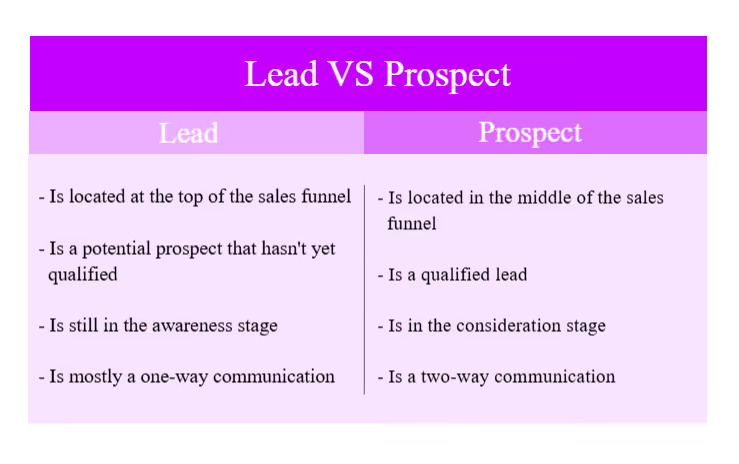
Effective prospecting involves researching, managing, and nurturing prospects to convert them into customers. Ideally, this also involves messaging across channels using email templates, timely cold calls, and even LinkedIn messaging. Managing all of this manually can be a major time suck, but that's where HubSpot’s prospecting tool can help.

Ready to fix your outbound process?
What are HubSpot Prospecting Tools?
HubSpot’s prospecting tool is a collection of sales and marketing tools to help you organize your leads and day-to-day tasks.
There are a few tools that we’ll cover in this guide that fall under the following categories:
- Prospecting workflow/workspace
- Lead identification
- Outreach and automation
- AI-powered enrichment and agents
HubSpot’s prospecting workspace
To get there, head to the Sales section in the left-hand navigation, select Sales Workspace, then select Prospecting on the resulting page.
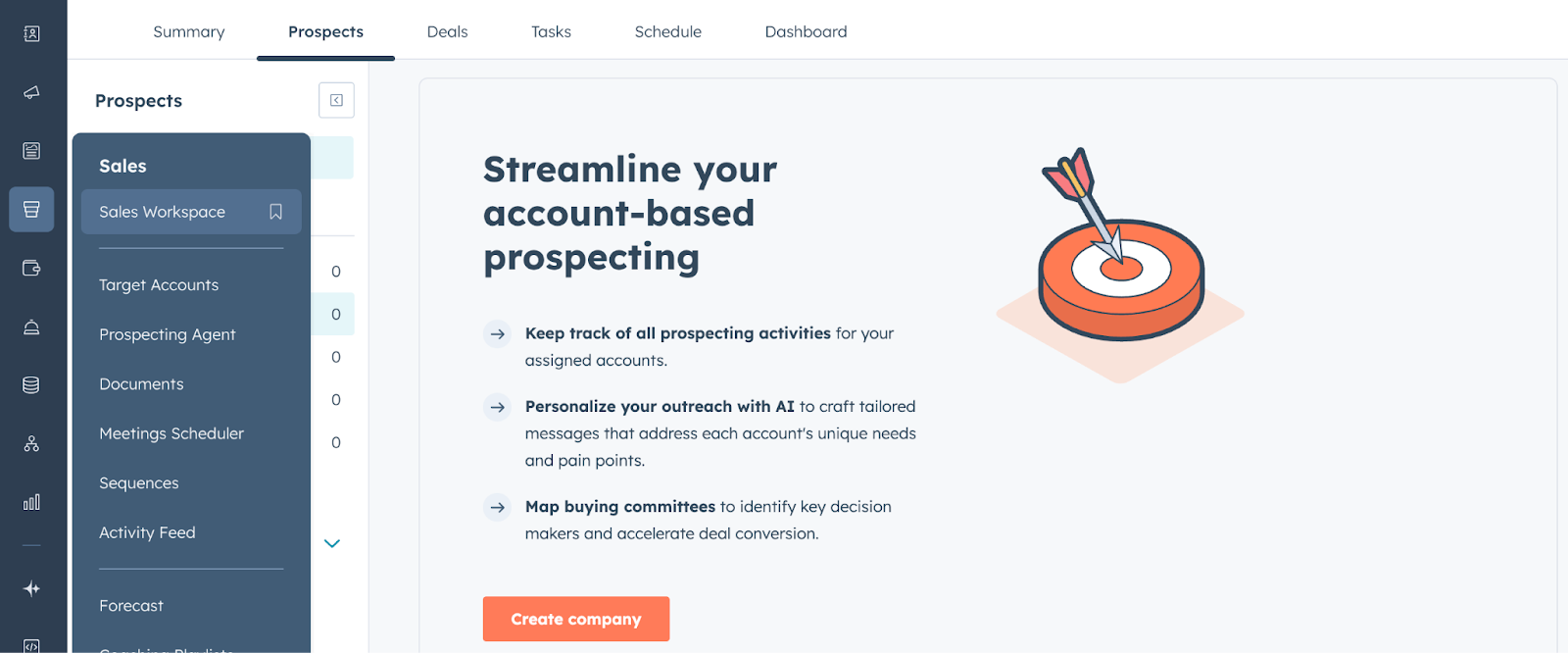
As you add leads and tasks, this workspace will give you a rich overview of every prospect you are working with, and exactly what you need to be doing every day. You can track things like:
- Upcoming tasks
- Overdue tasks
- Sequences that are running
- Newly assigned contacts
HubSpot tools for lead identification
HubSpot recently got into the anonymous website visitor game with Buyer Intent, a feature that identifies visitors to your website, whether or not they convert on a form.
Buyer Intent uses the HubSpot tracking code on your website to identify the known IP addresses associated with companies.
There are limits, though. If a company doesn’t have a known IP address or if its employees use a VPN, that can interfere with data. That said, from experience, the data is reliable and accurate, even if it’s not perfect (and for what it’s worth, none of these tools are perfect).
HubSpot tools for outreach
HubSpot’s outreach tools date back to the CRM's launch in 2016. Back then, HubSpot CRM was just a simple table for managing contacts, and SideKick for tracking email opens. These days, you use HubSpot for messaging across most outbound channels, like:
- Make outbound calls
- Send templates via email sequences
- Send SMS with integrations
- Prospect on LinkedIn and sync data and conversations
HubSpot’s AI-powered prospecting tools
The HubSpot prospecting agent is an AI-powered sales automation tool built into HubSpot's CRM that can help you with research, drafting messages, and sending messages to prospects. It’s part of the Breeze AI suite, HubSpot’s collection of AI-powered marketing and sales tools that automate tasks and generate content.
You can use the prospecting agent to…
- Gather company and contact information from HubSpot CRM data, public sources like LinkedIn profiles, company websites, news articles, and funding announcements to build a comprehensive picture of each prospect.
- Create custom outreach messages based on prospect data, your selling profile, and the specific pain points and value propositions you define.
- Schedule and send follow-up emails automatically based on engagement patterns, maintaining momentum without requiring manual intervention from your sales reps.
- Identify when prospects respond and adjust the outreach sequence accordingly, stopping automated follow-ups and flagging the conversation for a rep to take over.
Check out our guide to HubSpot’s prospecting agent for a full walkthrough.
Next, I’ll share an exact playbook to follow for using these prospecting tools in your daily workflow, to prepare for each day and manage active leads.
How to work HubSpot into your prospecting workflow
Prospecting is an exercise in consistent movement: you need to identify your targets and nurture them every single week to work them toward a conversation.
Here’s how I’d work HubSpot’s prospecting tools into your workflow:
- Identify and enrich prospects
- Set your game plan to stay organized
- Run outreach campaigns
- Automate follow-up
- Track your performance
Identify and enrich new leads
Other than warm intros and referrals, the people who recently visited your website are the best leads to prospect.
The reason is simple: they’ve heard of you, and if your marketing team does its job, the content they read should be good too. I like to use the following when sourcing leads in my CRM to reach out to:
- Buyer intent - a great way to spot potential leads who are not in your CRM yet
- Recent website visitors - if any of your active prospects have dropped by your website, make a point of reaching out to them ASAP.
Then, enrich them!
HubSpot offers native enrichment to retrieve data for contacts like company info, geography, and other properties, while external integrations like HubSpot Enrichment can find names, job titles, and LinkedIn URLs, giving you immediate access to accurate and up-to-date data that you can then use to guide your prospecting flow.
Manage your leads and tasks to stay organized
As mentioned above, HubSpot’s prospecting workspace is an excellent way to manage leads and HubSpot tasks.
The more organized you are, the easier it will be to set and manage a game plan for each prospect, which will drastically improve your chances of being heard and getting a response. I also like to prioritize high-value opportunities and ensure smoother transitions across lifecycle stages like MQLs and SQLs.
Effective prospecting requires a bit of luck, but with a sound strategy and good overview, you can make your own luck.
Run multichannel outreach campaigns
If you’re limiting your prospecting touches to just email, you are seriously missing out. HubSpot is a multichannel outbound powerhouse, offering tools for:
- Make cold calls through HubSpot or with a power dialer
- Enroll prospects into email sequences
- Connect an SMS integration for text messaging campaigns
- Use Hublead to create new contacts from LinkedIn and sync DMs and InMails.
No excuses now. Whether you want to run a cadence of Connect on LinkedIn > Email > Call > DM > Call again or Email > Connect on LinkedIn > DM > Call, you can do it all in HubSpot.
Build your cadences, be consistent, and you will get responses.
Automate follow-ups
HubSpot's automation features are second to none.
You can set up automated sequences and workflows to send follow-up emails and create tasks, or use the automated prospecting agent to research, enrich, and even email leads on your behalf.
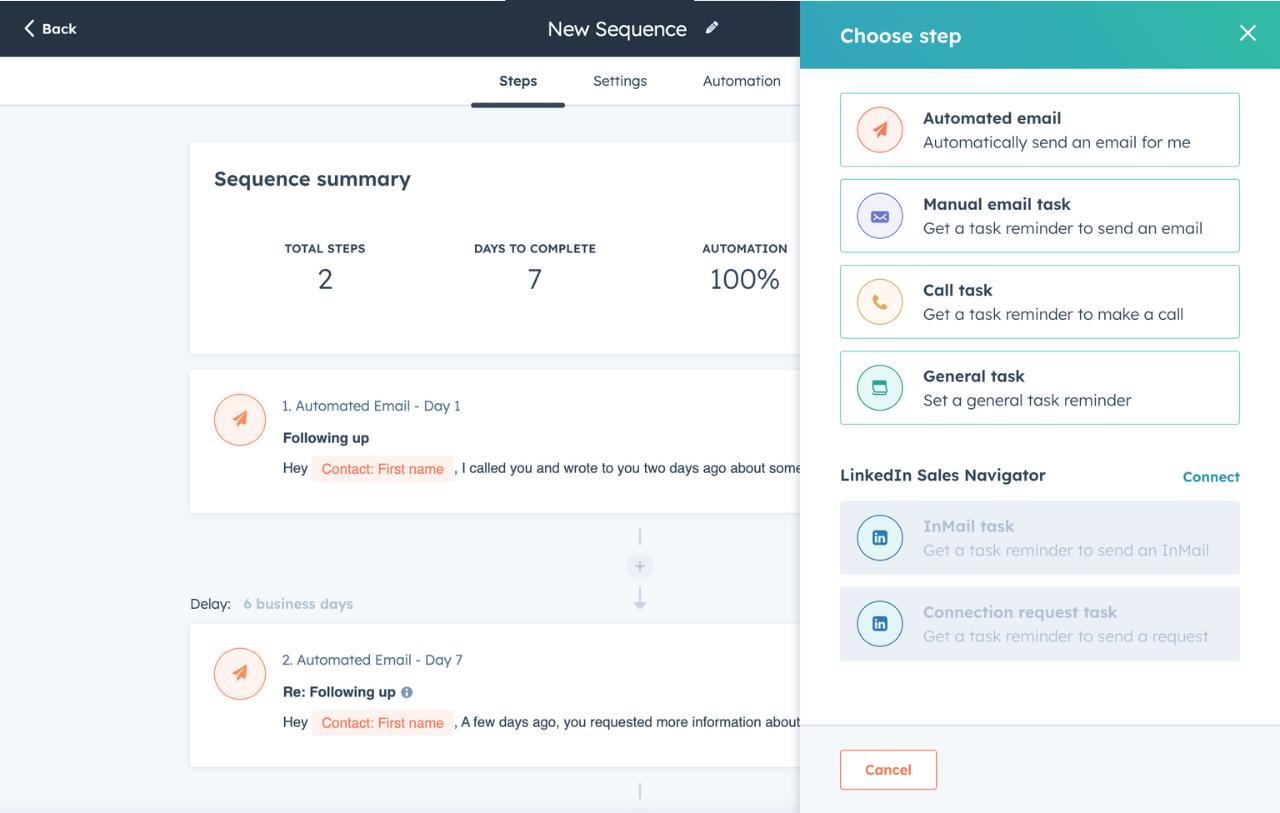
While the prospecting agent can’t replace you (yet), it can be highly effective at nurturing a subset of leads or acting as an assistant to your outbound campaign.
Track engagement and performance
All of this is a complete waste of time if you don’t track your performance and engagement.
It’s simple: are you starting conversations and booking calls? That’s what sales comes down to, which makes reporting on your performance easy in HubSpot.
- Track email opens: Use HubSpot’s email tracking to monitor when your emails are opened and clicked. This helps you gauge your prospects' interest levels and tailor your follow-up accordingly.
- Track LinkedIn engagement: Report on how many LinkedIn connection requests you sent and how many were accepted with Hublead.
- Track outbound performance: Generate visual, customizable reports to track key metrics like total revenue, average profit margin, year-over-year growth, conversion rates, and productivity with HubSpot’s reporting dashboards.
Reporting boils down to this: pick a metric that matters, and find a way to demonstrate how your prospecting activities contribute to it.
How to prospect on LinkedIn with HubSpot
There is no better channel than LinkedIn to build familiarity with your prospects, research them, monitor their activity, and demonstrate your authority and expertise.
The problem is, this is the one channel where HubSpot’s prospecting tools fall flat. HubSpot offers a native integration with LinkedIn Sales Navigator, but it is limited to the Advanced Plus tier of LinkedIn, and it can only be used to view profile data in HubSpot and send InMails.
What if you want to do things like:
- Add contacts to HubSpot from LinkedIn
- Sync DMs too
- Track who accepts your request to connect
- Create templates for LinkedIn messages
- Enrich contacts from LinkedIn
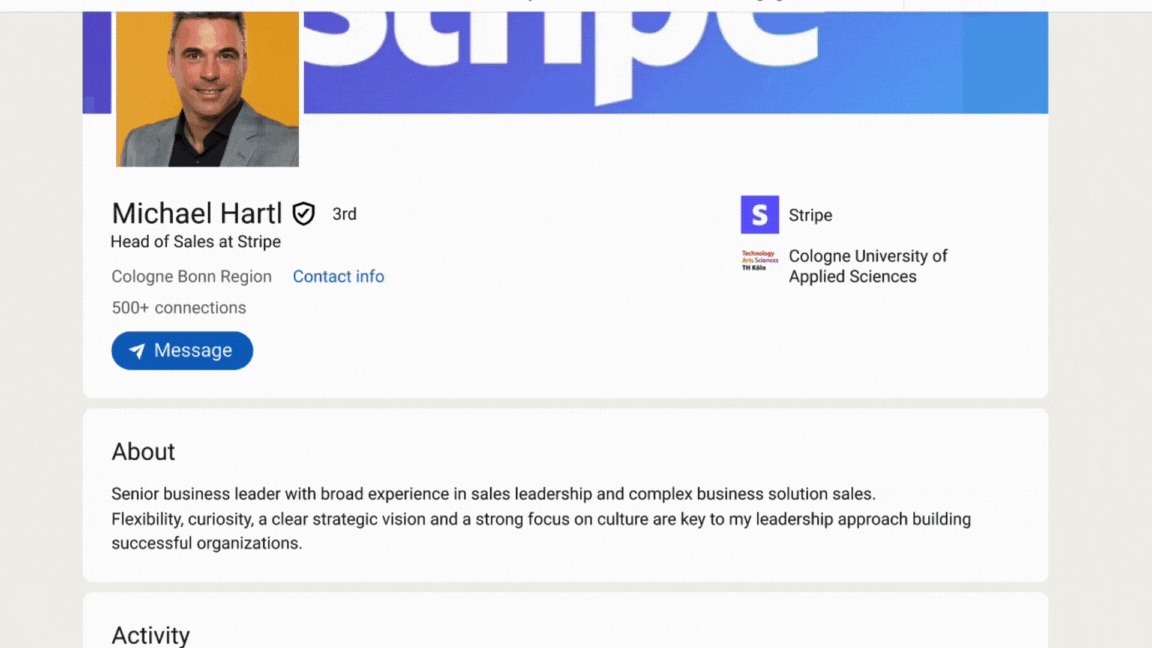
You can’t do that natively with HubSpot, but you can with Hublead! Hublead is a Chrome extension that seamlessly syncs LinkedIn with HubSpot. So go ahead and prospect all day on LinkedIn, every connection request and DM will sync straight back to HubSpot for your manager and team to see.
Try Hublead for free and see how much time you can save!
Best practices for using HubSpot's prospecting tools
HubSpot’s prospecting tools are fantastic, but they can’t guarantee success. That starts with you: your strategy, lead quality, and ability to show up every day across channels.
Here are a few best practices I’ll leave you with:
- Start with a winning strategy: Create a clear plan to deliver results by utilizing HubSpot’s tools for email outreach, event networking, and appointment setting. Use features like email tracking and scheduling to streamline follow-ups and engage prospects effectively.
- Mix up your channels: Spread yourself across channels to build familiarity with your prospects. Reps who limit themselves to email will start fewer conversations than those who mix in LinkedIn and the phone.
- Take advantage of education and support: Explore HubSpot’s resources, including sales prospecting courses and templates, to refine your skills. HubSpot’s innovative tools align with the inbound methodology, helping you deliver personalized outreach, search for opportunities, and sign high-value prospects.
Above all, remember that effective prospecting is an exercise in consistency. You can’t just prospect one day per week and expect a full pipeline. You need to constantly find, research, and engage new leads every single day.
The difference between a rep with a full pipeline and one with an empty pipeline is that the rep with a full pipeline shows up every day, ready to move leads across the board.
Ready to master outbound? Download the free HubSpot Outbound Handbook
HubSpot’s prospecting tools are great, but remember that success in outbound is less about a single magical template, striking lightning in a bottle, or having the ultimate AI tool.
It’s more about orchestrating messages and touchpoints. Identify your top prospects, choose your channels, and coordinate your touchpoints to get their attention.
If you really want to level up your sales process in HubSpot, download the free HubSpot Outbound Handbook, our guide to building a scalable and effective outbound process in HubSpot. In this guide, we cover:
- The channels to use
- How to get the attention of your prospects
- The tools you should use to speed up sales
And more! Click the button below to get it for free and start scaling your outbound process in HubSpot.
Ready to fix your outbound process?
Frequently Asked Questions
Does HubSpot include a prospecting tool?
Yes, HubSpot’s prospecting software streamlines lead management by offering a centralized view of tasks, helping sales teams stay organized and close deals efficiently.
How can I find prospects using HubSpot?
HubSpot’s prospects tool uses tracking code to detect IP addresses from site visitors, revealing publicly available company details. Access it by searching "Prospects" in your HubSpot account.
What does a prospecting tool do?
A prospecting tool helps businesses identify potential customers, capture their attention, and engage them effectively throughout the sales cycle.
What is HubSpot’s playbook tool?
HubSpot Playbooks allow sales teams to document and execute repeatable sales processes within the CRM, improving consistency and productivity.
.avif)
.avif)